

How to simply connect Astn’go IoT to increase industrial performance ?

The Internet of Things (IoT) has revolutionized industry, particularly in the field of production monitoring. Thanks to connectivity and real-time data, companies can optimize their operations, improve efficiency, and increase profitability.
What is an IoT ?

The Internet of Things (IoT) is a network of physical objects (sensors, machines, devices, etc.) connected to the Internet that can collect and exchange data in real time.
These objects can communicate with each other and with central systems, opening up new possibilities for tracking, automation, and optimization.
In this sense, IoT technology is a fundamental component of Industry 4.0.
In industry, IoT, often in the form of sensors, is used to collect and analyze data from production equipment. IoT sensors are installed on machines to measure various parameters such as speed, equipment status, etc. This data is then transmitted to a centralized system such as Astn’go for analysis.
Collect and analyze equipment data
Collecting and analyzing equipment data allows companies to monitor the status of their machines in real time, identify potential problems, and take corrective action before they cause production downtime.
But how is this production data collected ?
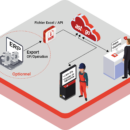
Astn’go IoT operates using wireless communication technology (Ethernet WiFi, 4G, 5G, etc.) or wired communication (wired Ethernet, RJ45, etc.).
By characterizing information, IoT Astn’go enables equipment to communicate “intelligently” by collecting and translating signals sent back by the equipment or production.
The Astn’go IoT is capable of reading and analyzing TOR (All or Nothing) signals, the most common in industry, which represent binary information such as on/off, part produced, etc.
For more information, see Machine signal processing
The IoT will then collect a set of signals from the equipment and send them in real time to the Astn’go production monitoring system.
Manual collection VS automatic collection with IoT
Before : manual data collection
- Labor-intensive process : Manual data collection is time-consuming and labor-intensive. Operators go out into the field, take measurements, and enter data, which can lead to delays and inefficiencies.
- Human error: Manual data entry is prone to errors. Operators may misread values or enter them incorrectly on paper, which can skew analyses and decision-making.
- Incomplete data : Manual data collection is often limited to spot samples. It is difficult to obtain a complete, real-time overview of operations, which can hinder the identification of problems and opportunities for improvement.
- Lack of responsiveness : Manually collected data is often available after a certain delay, limiting companies’ ability to respond quickly to changes and problems.
- Time wasted by managers : Between retrieving data from operators, consolidating it, and usually copying it into Excel files, managers waste a lot of time and cannot devote themselves to higher value-added tasks.
- Ineffective corrective actions : Manually collected data is often highly inaccurate. This leads to action plans that are often biased and corrective actions that are not sufficiently effective.
- Intuitive rather than factual piloting : Manual collection of plant data often results in a lack of analysis of the various causes of stoppages, breakdowns, slowdowns, etc. This leads to operators making estimates, which are sometimes far from reality.
- Operator disengagement: Faced with action plans that do not deliver the expected improvements, and with the heavy burden of always having to manually report the causes of equipment underperformance, operators quickly tend to lose motivation.
Afterwards: automatic collection with IoT
- Automation : The IoT automates data collection, reducing the need for human intervention and eliminating data entry errors. Data is collected continuously, 24/7, enabling constant monitoring of operations.
- Complete and accurate data : IoT sensors collect accurate and detailed data on all aspects of operations. This gives companies a comprehensive, real-time overview of their activities, enabling them to make informed decisions.
- Increased responsiveness: Data is available in real time, allowing companies to quickly detect problems and take immediate corrective action. This improves efficiency, reduces downtime, and optimizes performance.
- Operator engagement : With higher performance and better knowledge of equipment, operators are more engaged and take more responsibility.
- Time savings for management : The data collected is analyzed and processed in real time on customizable dashboards. Managers don’t need to retrieve, copy, and consolidate data.
- Optimization of corrective actions : With data analyzed using Astn’go algorithms, managers have all the knowledge they need to take precise and effective actions that will quickly improve performance.
- Streamlined piloting : Fully customizable manager dashboards are a valuable resource for optimizing workshop performance, implementing effective action plans, and striving for operational excellence.
Manual data collection is outdated in modern industry. IoT offers a much more efficient, accurate, and responsive solution for collecting and analyzing data. Companies that adopt IoT can improve efficiency, reduce costs, optimize operations, and make more informed decisions.
Benefits of IoT for production monitoring
The use of IoT for production monitoring offers numerous advantages:
- Reduction of various costs : by optimizing production, companies can reduce costs.
- Improved product quality : by identifying the causes of poor quality, companies can take corrective measures to improve the quality of their products.
- Increased profitability : by improving production efficiency, reducing costs, and improving product quality, companies can increase their profitability. They will be able to produce more and better in less time and with fewer resources.
What kind of ROI can I expect from installing an Astn’go IoT device?
For example, manufacturers using Astn’go quickly achieved the following ROIs:
- Prochimie : + 18% TEEP
- Jean Gielen : + 10 OEE points
- CGR Saint Yorre : + 15 productivity points
- Urgo : +5 OEE points
- GF Palette : + 15% OEE
Feeding production monitoring software with data from the IoT
Because the IoT does not only involve hardware, but also has a significant software component, it must be combined with a real-time field system: Astn’go.
The IoT is therefore at the heart of Astn’go’s architecture. Production monitoring software is a production management system that enables production managers to monitor and analyze key performance indicators (OEE, quality, performance, availability) for machines, lines, workshops, and production units in real time, thereby facilitating continuous improvement initiatives.
IoT data provides valuable information to production monitoring software, enabling it to improve production processes and strive for operational excellence.
AImproved OEE through equipment performance monitoring with the Astn’go IoT
Le suivi de la performance des équipements avec l’IoT permet d’améliorer le TRS (Taux de Rendement Synthétique). Le TRS est un indicateur clé de performance qui mesure l’efficacité d’un équipement de production. Il prend en compte la disponibilité, la performance et la qualité de la pro
Monitoring equipment performance with IoT improves overall equipment effectiveness (OEE). OEE is a key performance indicator that measures the efficiency of production equipment. It takes into account availability, performance, and production quality.
By using IoT data to monitor equipment performance in real time, companies can identify the causes of poor quality, micro-stops, lost time, etc. This allows them to take corrective action to improve OEE and increase production.
To learn more about OEE: What is OEE.
Astn’go, 1 week to connect the IoT and configure the software
While production monitoring software (MES software, OEE software, etc.) is traditionally time-consuming and costly to implement and maintain, Astn’go can be installed in just seven days for €119 per month per machine. See customer reviews
What’s more, all costs are included in the subscription, including software, IoT, support, maintenance, updates, hosting, and more.
Astn’go is easy, quick, and inexpensive to install, making it a risk-free investment that pays for itself in just a few days.
How about estimating the ROI you could achieve with Astn’go IoT in relation to your industrial process?
Conclusion
The IoT is transforming the manufacturing industry, particularly in the area of production tracking. With connectivity and real-time data, companies can optimize their operations, improve efficiency, and increase profitability. If you are a manufacturing company, it is important to consider using the IoT to improve your production tracking.
To learn more about Astn’go and the benefits you can gain from this solution, contact us via the link