

How many days does it take for Astn’go solution to pay for itself?

We will explain and prove to you how Astn’go is profitable from the very first month. Even in a pessimistic scenario with a gain of 3.3 OEE points, Astn’go’s payback period is 31 days. This scenario is very pessimistic because all of our customers see an increase in their OEE of between 5 and 15 points when using Astn’go. This means that Astn’go pays for itself in between 8 and 20 days.
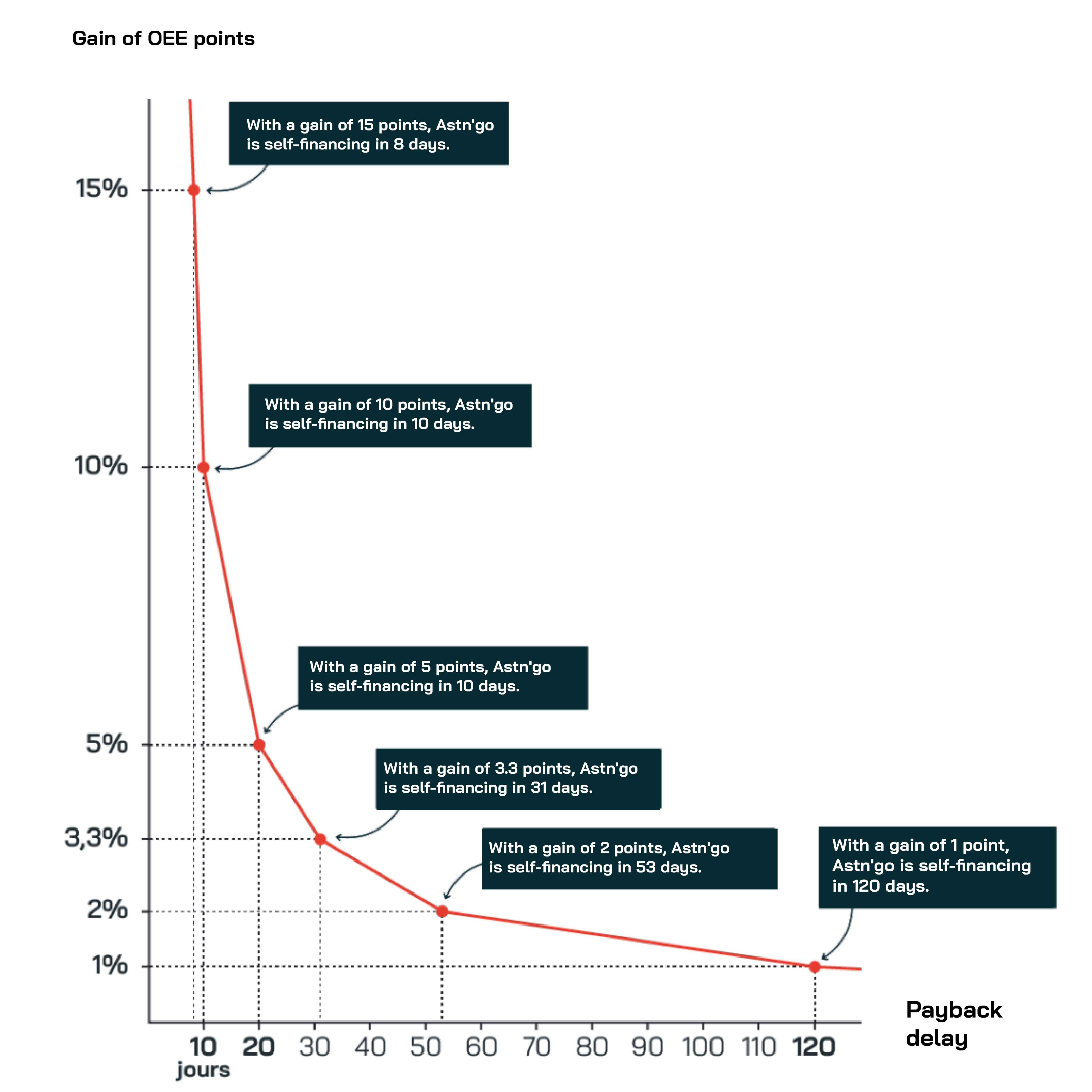
The data used to calculate ROI?
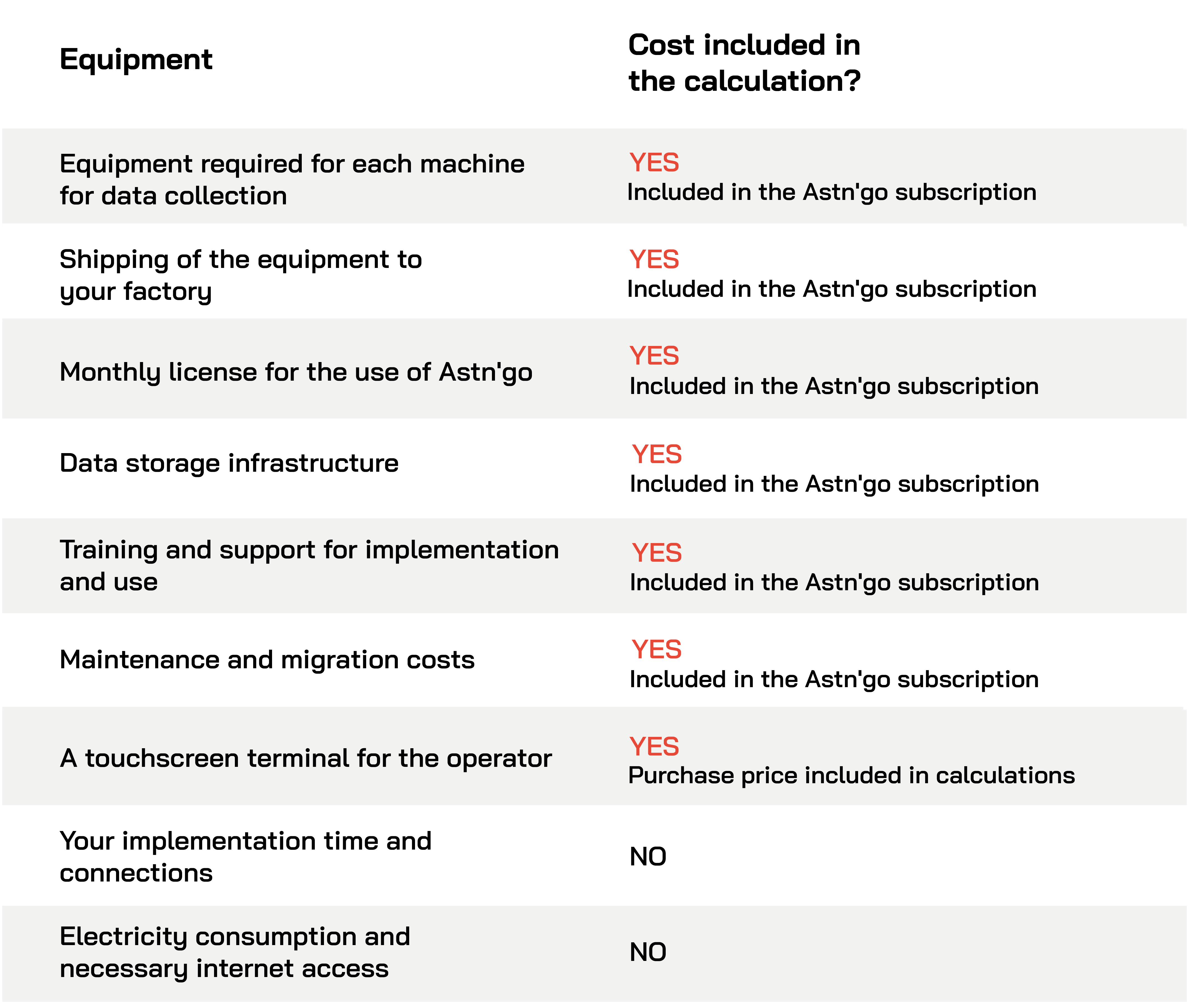
The costs
The calculations take into account all costs associated with setting up and using Astn’go, except for the time you invest in your factory.
The chosen method: value created
We chose to base the ROI calculation on the method of value created each year. This method is based on the operating costs of your machines (unit cost per hour set at $100) and the gain in OEE points (between 5 and 15 points according to our customers).
This method allows us to calculate the value created by Astn’go and thus deduce the return on investment. Our calculations are based on the following assumptions per machine:
- Hourly operating cost: $100
- Daily operating time: 16 hours
- Number of production days per week: 5
- Number of production weeks per year: 47
- Depreciation period for purchased equipment: 6 years
- Current OEE: 60%
The value created
The value created by Astn’go or the net financial gain (after expenses) generated by Astn’go is calculated using the following formula:
Value created = Machine operating cost (with current OEE) – Machine operating cost (with increased OEE) – Costs related to Astn’go (see above)
Return on investment (ROI)
It is calculated using the following formula:
ROI = Value created / Costs related to Astn’go (see above)
The payback delay
It corresponds to the number of days required for the Astn’go system to become profitable (i.e., to be self-financing and create value). It is calculated using the following formula:
Payback delay = 365 days / ROI
Want to calculate your ROI? Try our calculator on the homepage via this link: OEE non-binding software, 30-Days Free Trial
Examples of return on investment calculations
1. Case with a 10-point increase in OEE
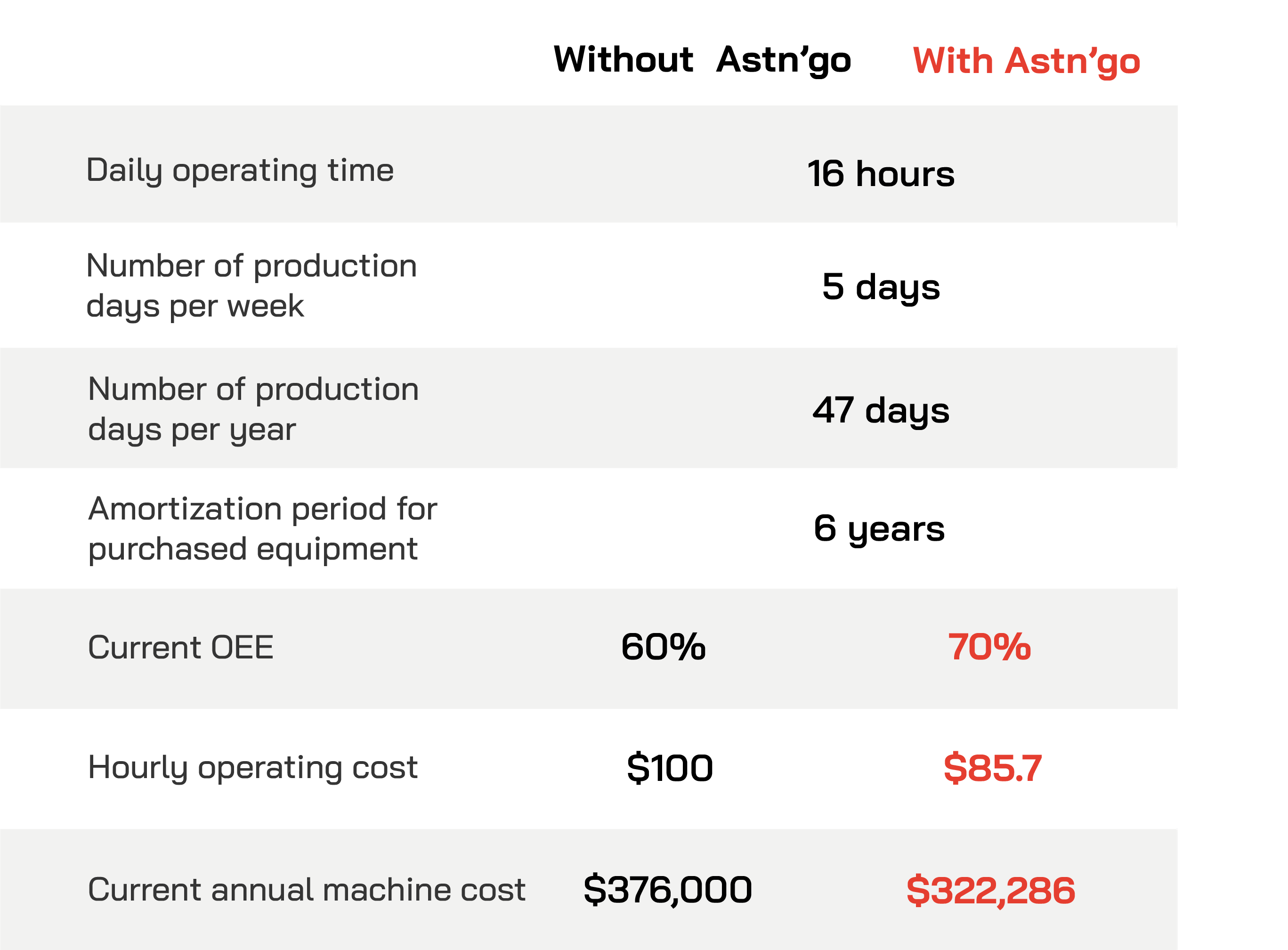
With a 10-point increase in OEE, which in this case represents a real increase of 16.7%, OEE rises from 60% to 70%. In our example, the hourly operating cost drops from $100 to $85.7, and the annual machine cost drops from $376,000 to $322,286. This represents a return on investment (ROI) of $52,180.
The payback delay is reached in11 days.
2. Pessimistic scenario with a 5-point increase in OEE
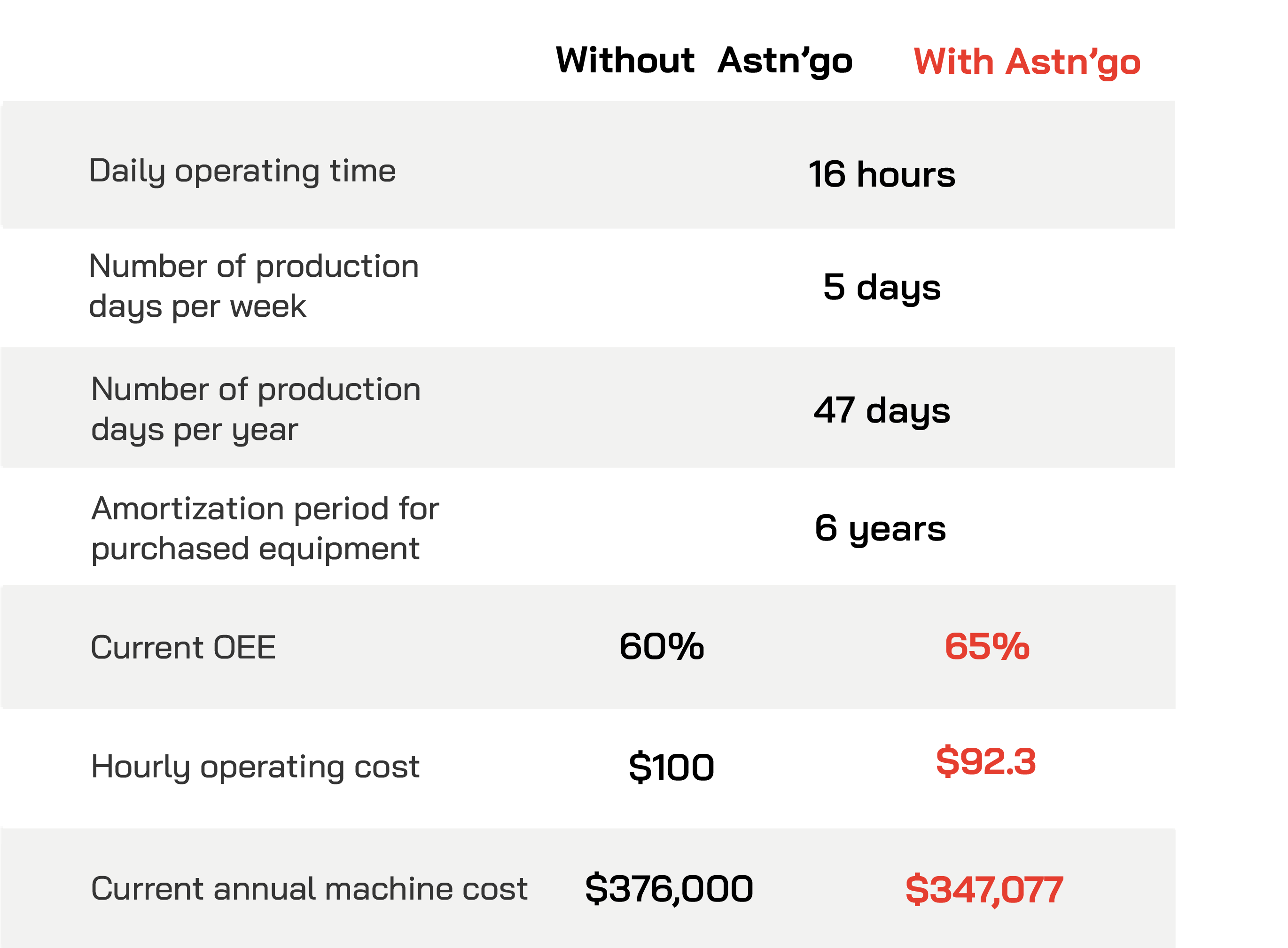
With a 5-point increase in OEE, which in this case represents a real increase of 8.3%, OEE rises from 60% to 65%. In our example, the hourly operating cost drops from $100 to $92.3, and the annual machine cost drops from $376,000 to $347,077. This represents a return on investment (ROI) of $27,389.
The payback delay is reached in 20 days.