

How to follow machining centers and CNC ?

Astn’go allows you to monitor production on a wide variety of CNC machines in different fields such as metal and plastic processing.
What data can you track on an CNC ?
The monitoring of an equipment generally involves measuring the cycle time of the production of a part in relation to a target cycle time defined by the WO, the reference or the equipment.
In the case of an CNC monitoring, it is not always obvious to measure the cycle time in a unitary way. Depending on the nature of the raw material and the WO/reference, it is possible to produce X products during a cycle. With Astn’go, the number of parts per cycle can be set at the WO/operation, reference or equipment level.
1 Measure the availability of your means of production
You can measure the availability of your means of production by comparing the machine’s operating time with the required time (the required time is equal to the opening time of the means of production minus the planned downtimes). This approach allows you to obtain the use rate of the equipment and a detail on the reasons impacting the proper functioning of this one, for example: downtimes, material supply, cleaning, breaks, technical downtime.
2 Measure the performance of your means of production
If the equipment and the process allow it, you can track the number of parts produced by the machine. This approach allows you to measure the performance of your equipment by comparing the time it takes to complete a part against the time initially planned.
How to follow a CNC machine with Astn’go ?
1 Collecting the operating time of the CNC machine
To know the operating time of your equipment, you need to connect the IIoT to the element that allows you to indicate that the machine is running. This signal is usually retrieved from the ANDON light columns, laser, spindle or other element that powers the IIoT when a production cycle is in progress.
The retrieval of a production cycle allows to identify if the machine is in production.
As shown in diagrams N°1 and N°2 below, Astn’go can determine the operating or downtime status of a production equipment according to the standard cycle time for the current production. This cycle time can be carried by the WO operation, the reference, the equipment.
2 Collecting performance with the counting of parts produced by a CNC machine
To retrieve the number of parts produced, the Astn’go IIoT must receive a signal indicating the end of a part or a cycle. This signal can come from a relay, fed by a sensor or by a signal sent following the configuration of the G code.
3 Evaluate the performance of a CNC machine
- If you only capture the operating signal of the CNC machine, you can measure the availability rate, a component of the OEE. With Astn’go, you can also analyze the reasons for the loss of productivity of the CNC machine via a Pareto of the downtime causes.
- If you receive a signal for the parts produced, you have the possibility to measure the performance rate of your machine in addition to the availability rate.
The performance rate will compare the actual cycle time for the completion of a part compared to the standard cycle time.
Two ways to collect data
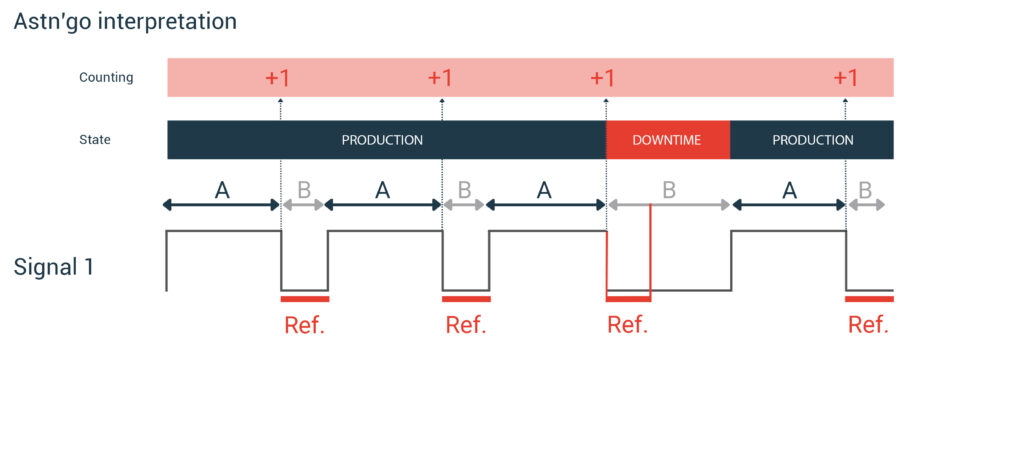
The diagram above explains how Astn’go can manage the on/off status and the parts count, in the case of a long cycle using a single signal.
The signal 1 collected corresponds to the machine operating. If the signal returned is 1 (time A), Astn’go considers that the machine is in production. When this signal goes to 0, Astn’go counts a part.
The time spent in position 0 (time B) will determine the status of the machine. Indeed, if this time B is lower or equal to the expected time between two products, then the machine remains in production. If this time B is greater than the expected time, then the machine is considered on downtime. In this case, Astn’go asks the operator to indicate the reason for this downtime from a list of configurable causes.
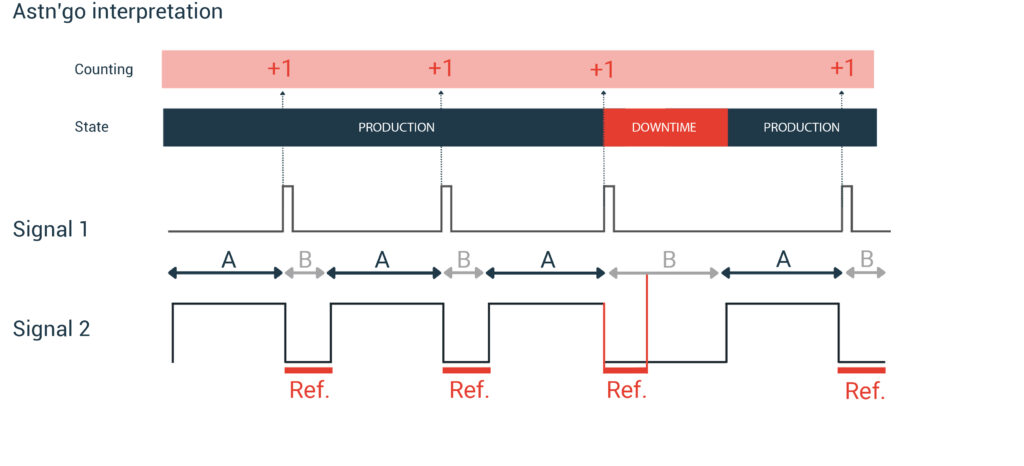
The diagram above explains how Astn’go can manage the on/off status of the machine and the pieces count, in the case of long cycles using two signals.
The example here shows that the management of the machine status is made reliable with the combination of two signals. In this example, a normal production cycle consists of a machine downtime and the addition of a product. If the machine downtime is not associated with a top part, then Astn’go considers the machine as being at a standstill. In this case, Astn’go asks the operator to indicate the reason for this downtime from a list of configurable causes.
Is Astn’go’s IIoT mandatory for collecting data from CNC machines?
To retrieve the data mentioned above, it is necessary to connect the IIoT to your machine. This data will be processed by the Astn’go application and displayed on the different screens to the operator and the manager in real time.
What process and what equipment?
This type of monitoring is particularly adapted to lasers, plasma cutters, water jets, CNC lathes, milling and punching machines…
Among the machine manufacturers : ESAB, Doosan, Okuma, Haas, Fermat, Finnpower, Amada, Bystronic, Feeler, Bumotec, Cazeneuve, Mazak, Robojob, Hermle, Tsugami, FANUC, Citizen-Cincom, Citizen-Miyano Huron, Index, TRAUB, Jyoti, Manurhin K’MX, Mori-say, Schütte, Somab, Wickman, Tornos, Weber.