


The importance of continuous improvement

Continuous improvement, what is it ?
Origins
During the Industrial Revolution, Frederick Taylor brought about major changes in the principles of production management and organization, giving birth to Taylorism. Industrial production capacity suddenly increased drastically. This generated unprecedented wealth, including a significant increase in workers’ wages. However, the worker no longer had a voice: he or she was told what to do, and not to think about how to improve the work.
It was at this point that a young engineer, Henry Gantt, proposed reintroducing the worker into the continuous improvement process. This was the birth of continuous improvement.
Definition
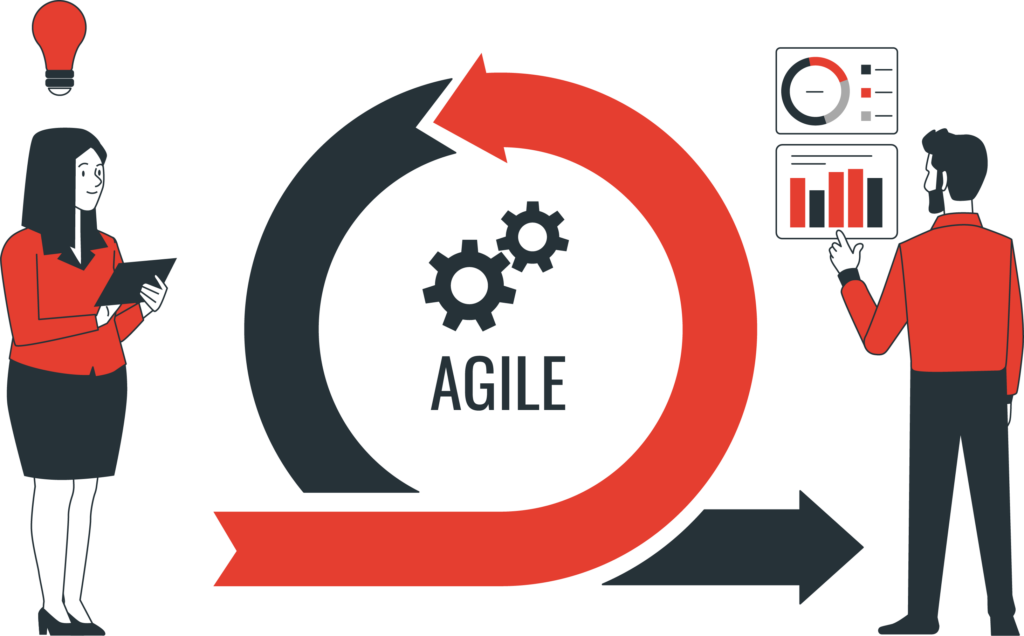
According to ISO 9000, continuous improvement is a “regular activity to increase the ability to meet requirements”. In other words, it’s a cyclical process that tends towards progress in order to achieve certain set objectives. It’s an infinite process: evolutions are constantly being made during each iteration.
The principles of continuous improvement
The PDCA/Deming Wheel method
The PDCA management method unfolds 4 complementary stages of continuous improvement:
- Plan: In this first stage, the aim is to define and analyze a problem. To do this, you need to identify the root causes of the problem you wish to solve.
- Do: The aim is to start implementing your solution, i.e. testing it with a pilot or a target group to see if it works.
- Check: This stage enables you to find out whether the solution works by extracting the results of your development.
- Act: Finally, you need to refine and adjust the final changes that will be introduced. Ultimately, the challenge is to find the best possible solution.
What’s the point?
For a company, setting up a continuous improvement process generally makes it possible to :
- Reduce waste: a continuous improvement approach enables you to detect your waste, i.e. anything that adds no value to your process (waiting time, overproduction, etc.) – the hunt for Mudas.
- Reduce malfunctions
- Reduce costs
- Reduce scrap
- Shorten lead times
- Improve business performance
This process also improves employee commitment and morale, as well as plant productivity.
Overall, these benefits add up. For example, when you reduce waste, you’re bound to increase your plant’s productivity and thus improve its performance. This common thread explains why each benefit tends towards the next.
TRS software & continuous improvement
Implementing a TRS software package in your workshop can help you to identify whether or not your objectives (quality, safety, performance, etc.) are being met. This type of solution offers a wide range of indicators for monitoring progress towards your objectives: Performance Rate, Synthetic Efficiency Rate, Economic Efficiency Rate, etc.
The real challenge in implementing a TRS solution as part of a continuous improvement process lies in the ability to make your approach sustainable. Indeed, we often speak of the yo-yo effect when we launch a continuous improvement approach: positive results are almost immediate… but nature takes over again, and performance falls back.
In this context, production monitoring software such as Astn’go remains a relevant tool. In particular, it enables you to automate data entry and retrieval methods. Generally speaking, data is digitized, and certain visualization tools will make real-time monitoring of your production more reliable.